Shut off the water first. The main valve is at the meter box near the curb (a meter key helps) or at the house; newer homes have one in the garage or utility room. If the pipe froze and hasn't thawed yet, leave a faucet open so water has somewhere to go as it does. Then call. Dallas Water Damage Cleanup sends an insured, IICRC-certified crew in your part of DFW, and your plumber fixes the pipe while they dry the house.
Clean-water burst-pipe dry-outs in DFW run about $500 to $1,500 for one room and $2,000 to $5,000 when a freeze burst crosses two floors, at $3 to $4.25 per square foot plus ceiling repair of $325 to $1,100 (Fixr, January 2025, source Voda DFW, April 7, 2025, source.
Freeze bursts: what February 2021 and January 2026 taught DFW
DFW sat at or below freezing for 139 consecutive hours in February 2021, bottoming at -2°F on the 16th, and the power was off in much of the metro for a day or more. Texas insurers logged 456,531 claims from that storm by March 31, 81.5 percent of them residential, with an average residential loss of about $11,500. Most of those were water. The January 2026 freeze was shorter but Dallas Water Utilities still took 207 burst-pipe calls in four days, and plumbers reported tank and tankless water heaters failing alongside the pipes.
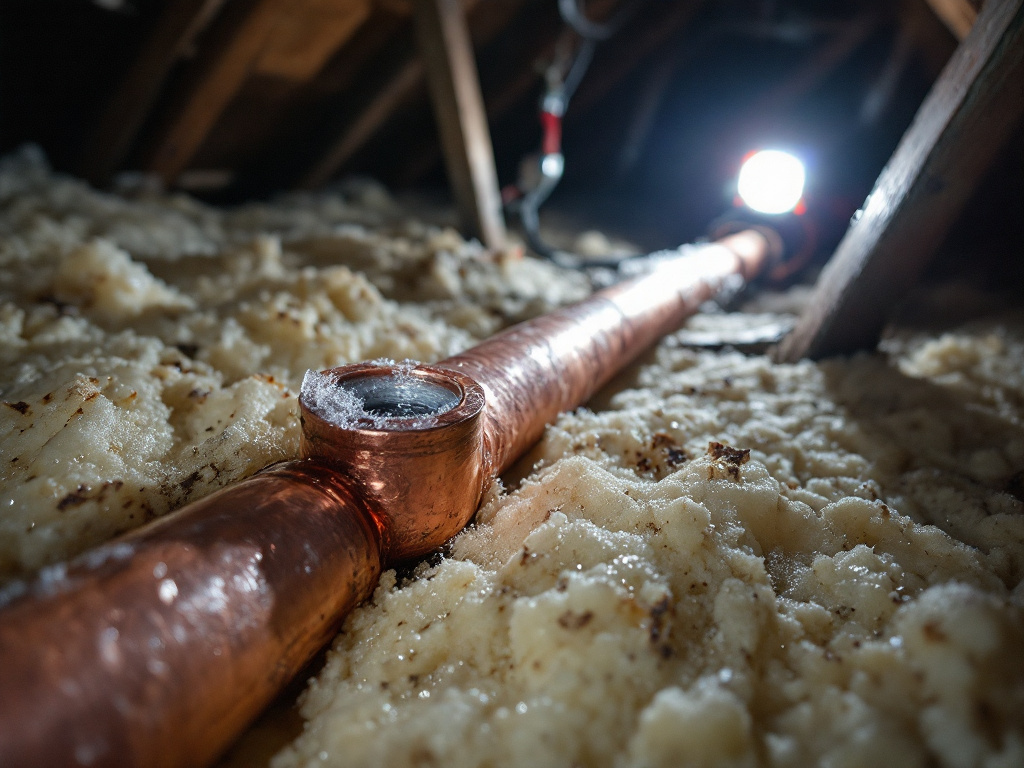
The DFW-specific lesson is attic plumbing. Builders here put supply lines, manifolds and often the water heater in the attic, where the only thing between the pipe and the outside air is a few inches of insulation that may or may not be covering it. When the house loses heat, the attic freezes first. The Dallas Builders Association's advice after 2021: PEX is more freeze-tolerant than copper and newer homes with PEX fared better, but no pipe is immune, and letting faucets drip during an outage still matters.
Slab leaks: the slow burst under your floor
The clay soil across Dallas, Collin and Tarrant counties swells when wet and shrinks in a dry summer, and the slab moves with it. Copper supply lines run under slabs poured in the 1950s through 1980s move too, and they fail at joints and from pinhole corrosion. The signs are a warm spot on the floor over a hot-water line, a water meter that moves with every fixture off, a bill that jumped, damp carpet with no obvious source, or a musty smell along a baseboard.
A slab leak isn't a flood; it's weeks of water under the flooring before you notice. By then the subfloor, the bottom plates and the lower drywall are often wet across more than one room. Cleanup means pulling flooring back to dry slab, drying the cavities, and coordinating with the plumber, who will either tunnel under the slab, jackhammer through it, or reroute the line overhead. Whether your insurer covers the access and the resulting damage (but not the pipe repair itself) depends on your form; many Texas policies do, some exclude it, and gradual-leak language can be used to deny it.
Water heaters and appliance lines
Tank water heaters in DFW attics sit in a pan with a drain line; when the tank rusts through, the pan is supposed to catch it and the line is supposed to carry it out. Pans crack, drain lines clog, and 40 gallons plus the continuous supply come through the ceiling below. Washing machine hoses, dishwasher supply lines, refrigerator ice-maker lines and toilet supply lines are the other common failures, and because they run until someone shuts them off, a leak that starts at 8 a.m. can put several hundred gallons into a house by the time you're home.
- Replace rubber washer hoses with braided stainless on a five-year schedule
- Put a leak alarm in the water heater pan and under the kitchen sink
- Know where the main shutoff is before you need it, and test that it turns
- If the water heater is in the attic, know where its pan drain terminates outside; dripping from that line is the warning
What it costs in Dallas-Fort Worth
Burst-pipe water is almost always Category 1, so it's the lower rate: $3.75 to $4.25 per square foot for extraction and drying in Fixr's January 2025 guide, $3 to $4 on a DFW company's April 2025 page. A single-room ceiling leak caught the same day is usually $500 to $1,500 to dry; a freeze burst that ran for hours through a two-story is $2,000 to $5,000 and sometimes more, because the drying area includes the attic, the ceiling cavity, both floors' walls and the flooring below. Fixr's ceiling repair range of $325 to $1,100 and drywall at $1.50 to $3 per square foot cover the typical rebuild. The plumber's repair is a separate bill.
What moves the price
How long it ran, how many floors it crossed, and whether the ceiling came down. A leak that drips for weeks under a slab costs more to dry than a burst that gushed for an hour, because the water has spread further. Hardwood over slab adds removal. During a regional freeze every crew is booked and some companies add a surcharge; the companies we send don't, they triage by severity.
How long it takes and what to ask
Three to five days of drying for a one-level clean-water burst; five to seven when the attic and a ceiling are involved. Rebuild is one to three weeks after that. Ask the crew to meter the ceiling and the wall cavities on both floors, beyond the room with the puddle. Ask whether the attic insulation is being removed or dried (wet blown-in insulation usually comes out). Ask for the daily moisture log. And get the plumber's invoice and a photo of the failed section of pipe; your adjuster will want both as proof the loss was sudden.