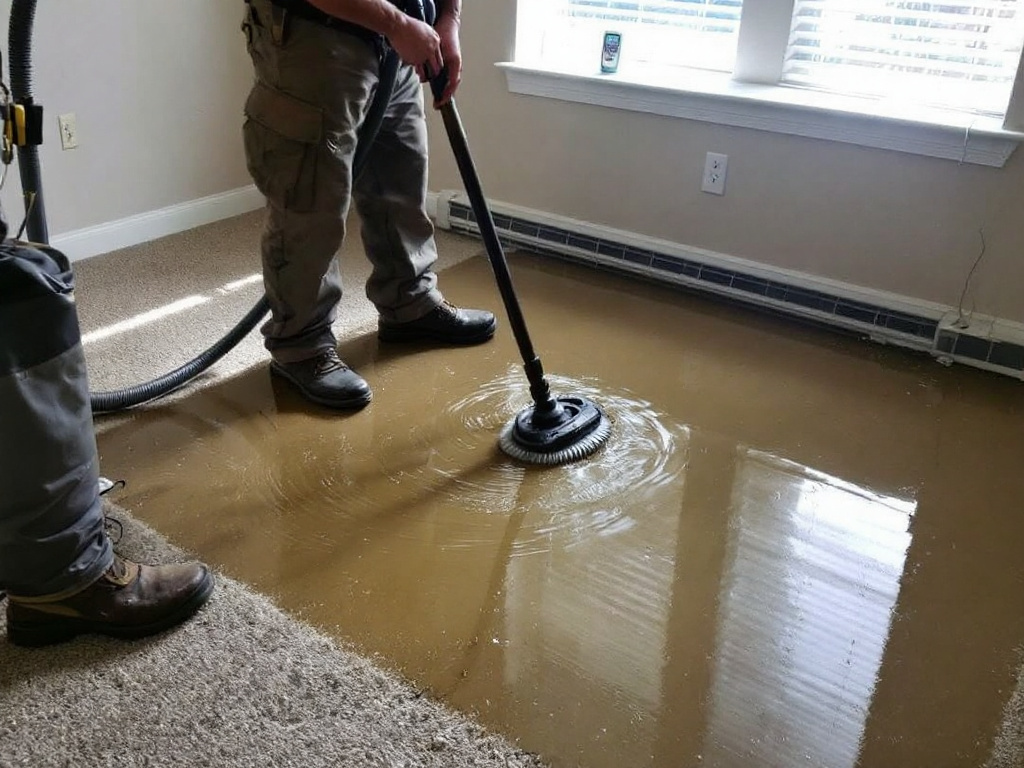
The houses in DFW fail in predictable ways. Copper under a 1960s slab pinholes. A 2004 two-story's attic water heater rusts through its pan. A washing machine hose lets go on a Friday and nobody's home until Sunday. An upstairs toilet supply line cracks and the kitchen ceiling comes down. Each one dries differently, and the crew's first hour is spent finding where the water went, not where it's visible.
Most DFW residential mitigation jobs run $1,200 to $5,000 at $3 to $7.50 per square foot by water category, with rebuild extra (Fixr national guide, January 2025, source Voda DFW pricing page, April 7, 2025, source.
How the work goes, day by day
Day one is extraction and demolition. The crew pulls standing water with a truck-mounted or portable extractor, lifts carpet to pull the pad, and uses pin and non-invasive moisture meters plus a thermal camera to map the wet area. Anything that has absorbed Category 1 water and can dry in place stays; anything that can't (pad, particleboard cabinet bottoms, swollen MDF trim, wet insulation) comes out. If the wall cavity is wet they cut drywall 12 to 24 inches up, in a straight line, so the patch is easy later. Then they set air movers and a dehumidifier sized to the room and leave them running.
Days two through five are monitoring. A tech comes back daily, reads every marked point, and logs it. The equipment comes out when readings match an unaffected reference area in the house, not when the floor feels dry. In a Dallas August with the air handler fighting the dehumidifier, a Class 2 bedroom typically takes three to four days; a Class 3 room where water wicked up the walls can take a week. Rebuild starts after the final dry log.
Signs the water went further than you can see
Baseboards that have pulled away from the wall or show a dark line at the bottom. Paint that bubbles when you press it. A musty smell two days later in a room that looked fine. Cupping or crowning in hardwood. Vinyl plank that clicks or lifts at the seams. A ceiling stain that's yellow at the edges and still soft in the middle. Any of those means the wall cavity or subfloor is wet, and surface drying won't reach it.
On a slab, water travels under flooring farther than you'd expect. A kitchen supply-line leak often shows up first as a damp patch in the adjacent hall closet, because the water follows the slab's low spot. The crew's meter map, not the puddle, defines the drying area.
- Warm spot on the floor: hot-side slab leak
- Water meter spinning with everything off: supply-side leak somewhere
- Ceiling stain under an upstairs bath or the attic unit: supply line, drain, or condensate pan
- Sudden spike in the water bill with no visible leak: under-slab or in-wall
What it costs in Dallas-Fort Worth
Fixr's January 2025 national guide puts extraction and drying at $3.75 to $4.25 per square foot for clean water, $4.10 to $6.50 for gray, and $7 to $7.50 for black water, with a $50 to $200 emergency fee and a total project range of $1,200 to $5,000. A Greater DFW restoration company's April 2025 pricing page matches: $3 to $4, $4 to $6, and $7 and up per square foot, with minor one-room leaks at $500 to $1,500 and multi-room jobs at $2,000 to $5,000.
Rebuild is priced per item. Drywall runs $1.50 to $3 per square foot installed and finished; a ceiling repair $325 to $1,100; interior painting, trim and flooring on top. Most DFW homeowners with a covered loss pay their deductible (on many Texas policies a percentage of the dwelling coverage, so check your declarations page) and the insurer pays the rest to the contractor or to you.
What moves the price
Category is the biggest lever. Clean water from a supply line in a tiled kitchen is the cheap end. Sewage in carpeted bedrooms is the expensive end because everything porous it touched is disposed of, not dried. After that it's time: water that sat for three days has soaked the bottom plate and probably the neighbor's wall too, so the demolition and drying area doubles. Material matters: tile over slab dries fast; engineered wood over a plywood subfloor on a pier-and-beam house in old McKinney or Denton can mean pulling the floor.
Access matters too. A leak in a two-story's second-floor bath that came through the kitchen ceiling means two floors of equipment and a ceiling rebuild. And after-hours calls carry a fee. A Tuesday-morning call is cheaper than a Saturday-night one, but waiting two days to save $150 is how you add a mold line item.
How long it takes
Mitigation: three to seven days of equipment in the house, with a daily visit. Rebuild: a week for drywall, texture and paint on a single room; two to four weeks when flooring, cabinets or a ceiling are involved, longer if your insurer's scope has to be negotiated before material is ordered. Ask your contractor for a written schedule with the dry-out and rebuild as separate phases so you know what's holding things up.
What to ask before you sign
Ask for the certificate of insurance and the IICRC certification numbers of the people who'll be in your house; you can check them at the IICRC global locator. Ask whether the quote covers mitigation only or mitigation and rebuild. Ask who the daily moisture log goes to and whether you get a copy. Ask what the warranty covers on the rebuild and for how long. And read any assignment-of-benefits paperwork before signing; you don't have to sign over your claim to get the water out.