Before anyone starts, two calls. One to your homeowners insurer, who will almost certainly tell you flood is excluded. One to your flood insurer, if you have an NFIP policy, because that claim has its own adjuster and its own documentation rules. If you have neither, you're paying out of pocket, and the scope of the cleanup should be decided with that in mind.
Outside floodwater is billed at the Category 3 rate, $7 to $7.50 per square foot for extraction and drying before tear-out disposal and rebuild (Fixr, January 2025, source Bob Vila, May 2023, source.
What flood cleanup involves
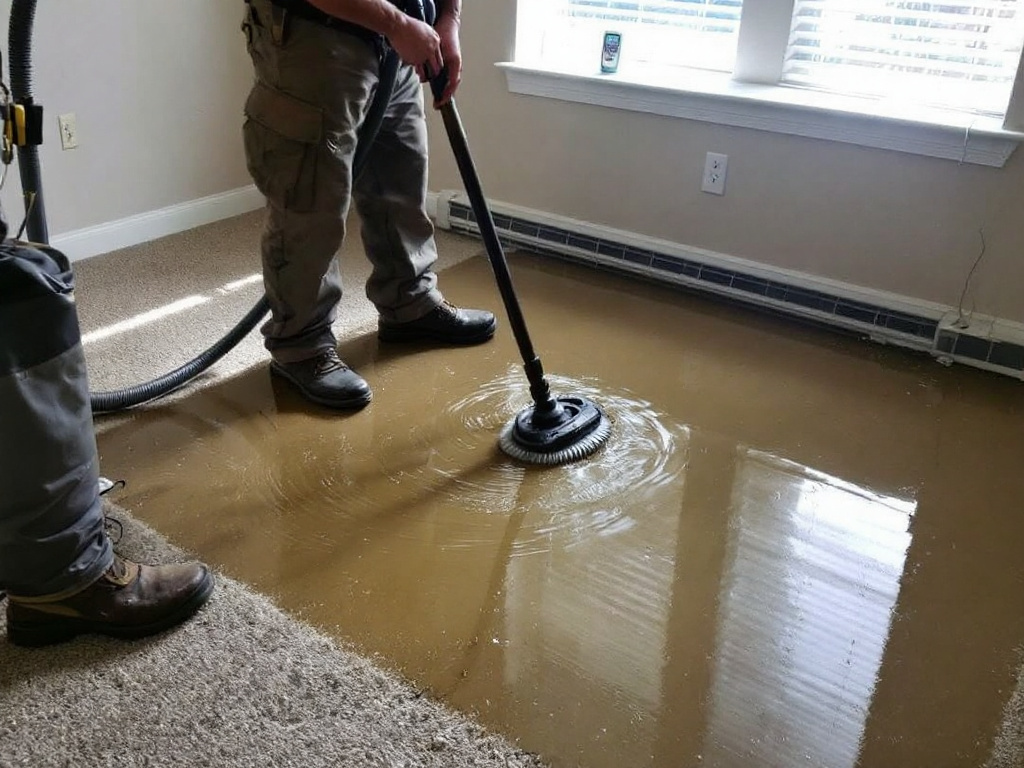
Extraction first, then removal of everything porous the water touched: carpet and pad, laminate and floating floors, the bottom two to four feet of drywall and the insulation behind it, particleboard cabinets and vanities, and any upholstered furniture that was in the water. Hard surfaces (slab, studs, tile) are cleaned, treated with an EPA-registered antimicrobial, and dried with air movers and dehumidifiers. The crew documents each item removed with photos; that inventory is your claim.
Flood cleanup also means looking at systems. If water reached the air handler closet, the outdoor condenser pad, the electrical panel, or the gas water heater, those get inspected by the right trade before they're turned back on. The restoration company handles the structure; the plumber, electrician and HVAC tech handle their equipment. Expect the dry-out to take five to ten days on a flooded first floor.
Where DFW floods, and what that means for your house
It's creeks and lake margins, not rivers, that put water in houses here. In May 2015 Mountain Creek overflowed into Grand Prairie's Willowbend mobile home park and surrounded 42 homes in four feet of water; the same week Duck Creek in Garland rose more than 30 feet overnight and put three feet of water through homes near it. In June 2015 Lake Grapevine topped its spillway for the first time since 1981 and Denton Creek flooded yards and some homes in Flower Mound, Coppell and Lewisville. In February 2018 Rockwall Lake overflowed into 21 houses in the Lake Estates subdivision. In August 2022 East Dallas got 15.1 inches in 24 hours.
If your house is near Rowlett Creek, Spring Creek, Duck Creek, Johnson Creek, Walnut Creek, Timber Creek or any lake shoreline, water can come in through the slab edge, the weep holes in the brick, and the garage. Even outside the mapped floodplain: FEMA says almost a third of its flood claims come from outside high-risk areas.
What it costs in Dallas-Fort Worth
Because floodwater is Category 3, the price is the black-water rate. Fixr's January 2025 guide puts black-water extraction at $7 to $7.50 per square foot and Bob Vila's guide at the same $7.50, versus $3.50 for clean water. A flooded 1,200-square-foot first floor is $8,400 to $9,000 in extraction and drying alone before any tear-out disposal or rebuild. Fixr's example of a sewer-flooded basement at $50,000 is the high end; DFW homes rarely have basements, but a whole first floor can get there once cabinets and flooring are replaced.
Rebuild after flood is bigger than after a pipe leak because more was removed: drywall at $1.50 to $3 per square foot installed, new flooring, new lower cabinets, new baseboards, and often new interior doors. Get the mitigation scope and the rebuild scope as separate documents.
Insurance after a flood
Homeowners policies in Texas exclude flood, including the mold a flood causes; TDI says so plainly. NFIP flood policies cover the building and, if you bought it, contents, with their own deductibles and a 30-day waiting period on new policies, so you can't buy one when the creek is already rising. If you have an NFIP policy, call the number on it, photograph everything, and don't throw out damaged items until the adjuster has documented them; keep swatches of carpet and flooring. If you have no flood policy, ask your city about disaster assistance; after the August 2022 Dallas flood the state sought federal help for the roughly 800 uninsured homes.
How long it takes
Extraction and tear-out on a flooded first floor is one to two days with a full crew. Drying is five to ten days because the slab and the bottom plates hold water. Rebuild is three to eight weeks depending on how much came out and how fast the claim settles. After a regional event, add time: every crew in DFW is booked and material lead times stretch.
What to ask
Ask whether they treat outside floodwater as Category 3 (the answer should be yes, always). Ask what antimicrobial they use and whether it's EPA-registered. Ask for a photo inventory of everything removed. Ask whether they'll inspect for mold before closing the walls and whether a TDLR-licensed assessor will be involved if growth is found. Ask for the certificate of insurance. And ask them to put the mitigation and rebuild in separate scopes.