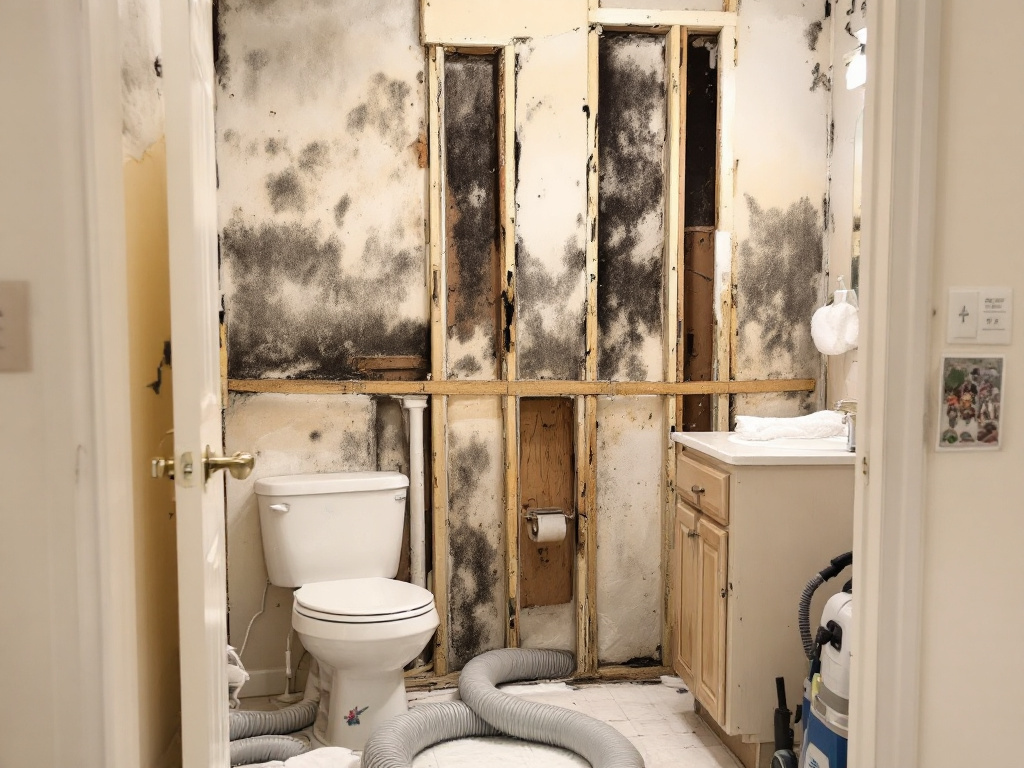
In DFW it grows where water sat unseen: behind the drywall below an attic air handler that overflowed its pan in July, under vinyl plank over a slab leak, in the insulation above a bathroom that leaked for a season, in a closet that shares a wall with a shower. It needs moisture, so the first step of every job is finding and fixing the water. Remediation without that is a cleaning you'll pay for twice.
Licensed mold remediation runs $1,500 to $9,000 for most homes at $10 to $30 per square foot, with attics $1,500 to $9,000 and HVAC systems $3,000 to $10,000; inspection $450 to $800 separate (Fixr, August 29, 2025, source small add-on during a DFW water job $500 to $3,000, Voda DFW, April 7, 2025, source.
How licensed remediation works
The assessor's protocol defines the work area and the method. The remediator seals that area with plastic and zippered doorways, puts it under negative air pressure with a HEPA-filtered air scrubber exhausting outside, and shuts off the HVAC to that zone so spores don't travel. Workers in respirators and suits remove contaminated porous materials (drywall, insulation, carpet, pad, particleboard) in sealed bags, then HEPA-vacuum and wet-wipe every remaining surface, then treat it. Framing with surface growth is cleaned, sanded or media-blasted, and sealed.
When the remediator finishes, the assessor comes back for a post-remediation clearance: visual inspection and air or surface samples compared to the protocol's targets. If it passes, the remediator and assessor complete the Certificate of Mold Damage Remediation (TDI form MDR-1), which states the mold was removed and the underlying cause fixed. Texas law requires the remediator to provide it. Only then does the rebuild start.
What it costs in Dallas-Fort Worth
Fixr's August 2025 guide puts mold remediation at $1,500 to $9,000 for most homes, a national average of $3,500, and $10 to $30 per square foot. By location: a bathroom $500 to $1,500, a crawl space $500 to $2,000, a basement $1,500 to $4,000, an attic $1,500 to $9,000, inside walls $1,000 to $12,000, HVAC systems $3,000 to $10,000, and a whole house $10,000 to $30,000. The assessor's inspection is separate at $450 to $800, and the clearance inspection is a second fee.
A DFW restoration company's April 2025 page lists mold remediation as a $500 to $3,000 add-on to a water job, which is realistic for a small area found during a dry-out. Fixr's January 2025 water damage guide lists mold work at $4.75 to $5.50 per square foot within a restoration project. The gap between those figures and $10 to $30 per square foot is containment, licensing and lab work; a small patch cleaned during a water job is cheaper than a stand-alone licensed remediation.
What moves the price
Square footage is the base. After that: location (attic work in a Dallas summer is slow and hot; inside-wall work means demolition and rebuild), whether the HVAC system is contaminated (duct cleaning or replacement is the expensive branch), how much material has to come out, and whether the moisture source is simple (a supply line) or structural (a slab leak, a roof). Access matters: a crawl space under a pier-and-beam house in old Denton or McKinney is a different job than an open garage wall. Lab fees and the clearance visit are on top.
Insurance and mold in Texas
TDI's guidance: mold that grows on an item damaged by a covered sudden water loss is covered as part of that loss; mold from a gradual leak, from seepage, or from a flood is not; and most policies don't include mold cleanup and testing after the damaged item is removed unless you bought that coverage. TDI's 2018 comparison of carrier forms lists mold remediation as a common exclusion that some companies let you buy back. Your insurer will want the licensed assessment, the protocol, and the certificate. Keep every one of them.
How long it takes
A bathroom or single-wall job: two to four days of remediation plus lab time for clearance. An attic or a multi-room job after a flood: one to two weeks. Add the assessor's lead time at the front and three to five business days for clearance results at the back. Rebuild follows. Plan on three to five weeks from first inspection to a finished, painted room on a typical DFW job.
What to ask
Ask for the TDLR mold remediation contractor license number and check it. Ask who wrote the protocol (it should not be them). Ask how they'll contain the area and where the air scrubber exhausts. Ask whether the HVAC will be shut off or sealed in the work zone. Ask what gets removed versus cleaned, in writing. Ask about the clearance inspection and the certificate. And ask what fixes the water source, because if the answer is nothing, the mold is coming back.