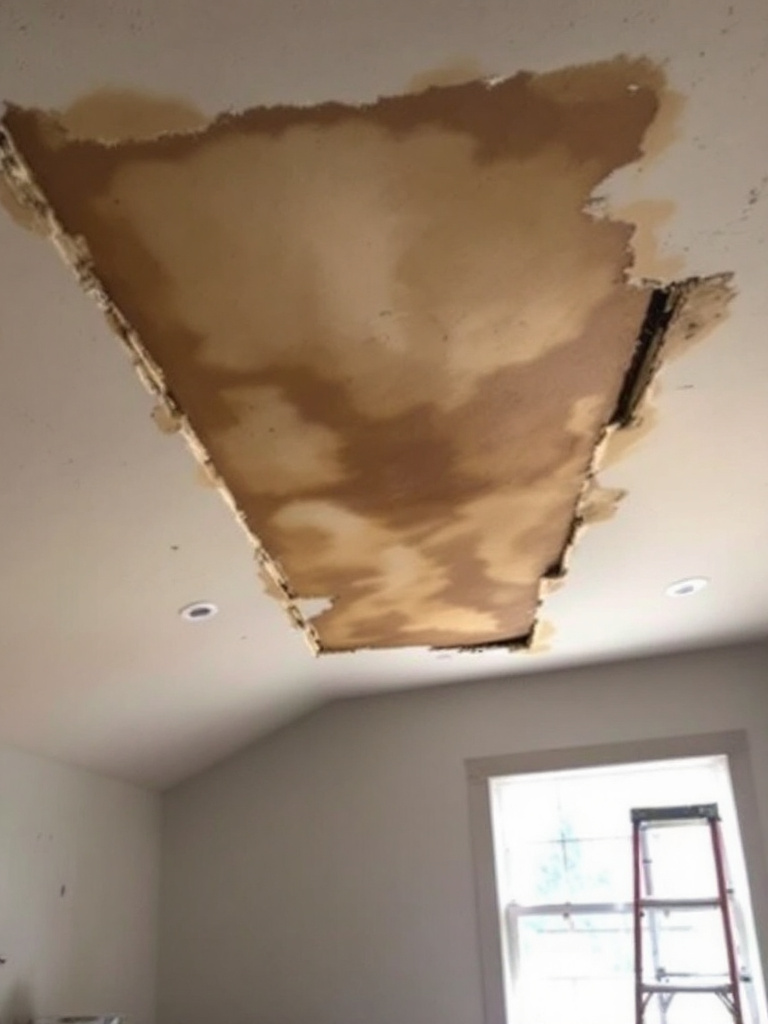
Right after the storm: get the opening covered. A roofer or the restoration crew tarps the roof and boards the window the same day; that's emergency mitigation your policy expects you to do and will pay for. Then photograph the damage inside and out before anything is moved, and call your insurer. If someone knocks on the door offering to handle your claim for a signature, read what they're asking you to sign. You don't need to assign your claim to anyone to get your house dried.
Interior drying after storm intrusion runs from about $615 to $975 for one 150-square-foot bedroom at the gray-water rate to $3,150 to $3,375 for 450 square feet of Category 3 water, plus ceiling repair of $325 to $1,250 and the roof (Fixr, January 2025, source Bob Vila, May 2023, source.
What storm restoration involves
Emergency tarping and board-up, then interior assessment with a moisture meter and thermal camera: wet attic insulation under the roof damage, the ceilings below it, the walls the water ran down, and the flooring. Wet blown-in insulation comes out; it holds water against the ceiling drywall and doesn't dry. Sagging ceilings are opened. Air movers and dehumidifiers run until the structure is dry, with daily readings logged. Then rebuild: insulation, drywall, texture, paint, trim, flooring. The crew coordinates with the roofer so the roof is watertight before the ceilings are closed.
Rain that came through a roof is treated as Category 2 or 3 depending on what it crossed (wind-driven rain through a weather event is Category 3 under the IICRC S500 standard), so insulation and drywall it soaked are usually removed rather than dried in place. Water that came in through a broken window onto a floor is a simpler clean-water dry-out if it's caught the same day.
What DFW storms do to houses
Hail is the signature. It cracks pipe boots, dents and splits shingles, and the leak shows up in the next rain as a ceiling stain. Straight-line wind and tornadoes do the dramatic damage: the December 26, 2015 EF4 that crossed Interstate 30 at the George Bush Turnpike severely damaged or destroyed more than 600 homes and businesses in Garland and Rowlett and killed 10 people. Flash flooding does the rest: the August 22, 2022 storm put 15.1 inches on East Dallas in 24 hours and water into homes from Balch Springs to Old East Dallas.
The quieter version is the one most homeowners deal with: a spring hailstorm, a roof that looks fine from the ground, and a bedroom ceiling that drips in October. By then the insulation has been wet more than once. The restoration crew's job is to find how far the water went, and the roofer's job is to find how it got in.
What it costs in Dallas-Fort Worth
The interior water portion is priced like any water loss. Fixr's January 2025 guide puts extraction and drying at $4.10 to $6.50 per square foot for gray water and $7 to $7.50 for Category 3, with ceiling repair at $325 to $1,100 and drywall at $1.50 to $3 per square foot; Bob Vila lists a leaky-roof interior repair at a $1,000 national average and ceilings at $350 to $1,250. Worked through: a 150-square-foot bedroom with rain through the ceiling is $615 to $975 to dry at the gray-water rate, plus $325 to $1,250 for the ceiling, plus insulation and paint. Two rooms and a hall at 450 square feet of Category 3 water is $3,150 to $3,375 to dry before any rebuild. Tarping is billed as emergency mitigation and your policy expects you to do it.
What moves the price
How long the leak ran before you noticed (a hail hit in April that drips in October has wet the insulation repeatedly), how many rooms the water crossed, whether wet insulation has to be replaced across a large attic area, and whether the water reached the air handler or electrical in the attic. After a regional hailstorm every roofer and restoration crew in DFW is booked, and tarps can stay on for weeks while roofs are scheduled; interior drying shouldn't wait for the roof, and the crews we send will dry under a tarp.
Insurance and the 2017 law
Wind and hail are named perils on every Texas form, and most DFW policies carry a separate wind/hail deductible, usually a percentage of the dwelling value; check your declarations page. Since September 1, 2017, lawsuits over weather-related property claims in Texas fall under Insurance Code Chapter 542A, created by HB 1774: if you end up suing your insurer, you have to send written notice at least 61 days first stating the amount you believe you're owed, and the insurer can demand to inspect. It changed litigation, not the claims process. Your deadlines are the same: report promptly, document, mitigate, keep receipts. Under Texas law the insurer has 15 business days to acknowledge and 15 business days after it has your documents to decide.
How long it takes and what to ask
Tarp and dry-out in the first week; rebuild after the roof is done, typically two to four weeks for ceilings, insulation and paint. Ask the crew to meter the whole ceiling area under the damaged roof section, not only where it's stained. Ask whether insulation is being replaced. Ask them to coordinate the ceiling close-up with the roofer's completion. Ask for the moisture log and photos of the open attic for your adjuster. And don't sign an assignment of benefits or a contingency agreement at the door; the companies we send don't use them.