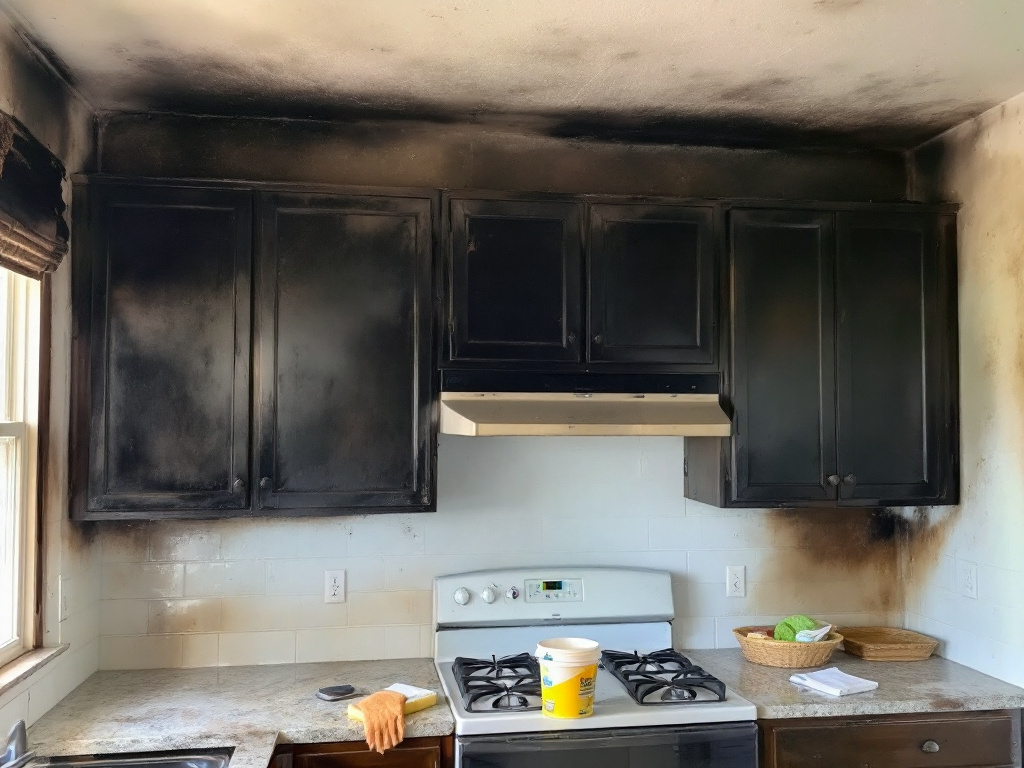
Don't go back in until the fire department says you can, and don't start cleaning when you do. Soot smears and sets when it's wiped with the wrong cleaner, and the acidic residue from burned plastics starts etching metal and glass within hours. Call your insurer, photograph everything, and let the crew do the first pass. Your job in the first day is a list: what you need from the house right now (medications, documents, clothes for a few days), and where you're sleeping.
Fire and smoke restoration ranges from $257 to $3,605 for cleaning and minor repair up to $20,244 or more with structural work, before the firefighting-water dry-out priced at $4.10 to $6.50 per square foot (Thumbtack national cost guide, October 20, 2026, source Fixr, January 2025, source.
What fire restoration involves
Day one is emergency service: board up broken windows and doors, tarp any roof opening, extract the firefighting water, and set drying equipment in the wet rooms so the water loss doesn't become a mold loss on top of the fire. Then the assessment: what's structural damage, what's smoke and soot damage that can be cleaned, what's a total loss. The crew packs out salvageable contents to a facility where they're cleaned, deodorized and inventoried, and that inventory becomes your contents claim.
Soot removal is surface by surface. Dry soot from a fast, hot fire comes off with chemical sponges; wet, greasy soot from a smoldering fire or a kitchen fire needs solvents and more labor. Walls and ceilings are cleaned, then sealed with an odor-blocking primer before paint. Odor is treated at the source (anything charred comes out), then in the air with thermal fogging, ozone or hydroxyl generators, and in the HVAC system, which pulled smoke through every duct in the house. Rebuild starts when the structure is clean, dry and sealed.
The water side of a fire
Firefighting water is Category 2 at best, because it has washed through burned materials. It soaks the floors of the fire room and runs into the rooms beside and below it. In a DFW two-story, a bedroom fire upstairs means the downstairs ceilings come down and the first-floor walls get opened. The drying has to start the same day as the board-up; the crew can't wait for the fire adjuster. The daily moisture log on the water portion is the same as on any water loss, and it's what keeps the mold out of a house that's already going to be empty for weeks.
What it costs in Dallas-Fort Worth
Fire costs vary more than any other restoration category because a small kitchen flare-up and a room-and-contents fire are different scales. Thumbtack's October 2026 national cost guide puts the typical range at $257 to $3,605 for cleaning and minor repair, with a low of $84 for a small smoke job and $20,244 or more for projects involving structural repair, and notes a kitchen fire usually costs more than a bedroom fire. On top of that, the water portion is priced like any water loss: $4.10 to $6.50 per square foot for gray water in Fixr's January 2025 guide, plus drywall at $1.50 to $3 per square foot and ceilings at $325 to $1,100.
To put the per-square-foot figures together: a 300-square-foot kitchen and breakfast area with firefighting water on the floor is $1,230 to $1,950 to extract and dry at the gray-water rate, before any soot cleaning, sealing, paint, or cabinet replacement. A room fire with water through the floor below runs from the tens of thousands up, and the rebuild is bid like a remodel. Your policy's dwelling, contents and loss-of-use limits are the ceiling on all of it.
What moves the price
Type of fire (protein fires from cooking leave an invisible, stubborn film; plastic and synthetic fires leave greasy black soot), how far smoke traveled (through the HVAC, it went everywhere), how much water the fire department used, how much contents has to be cleaned or replaced, and whether the structure needs engineering. Odor is the cost that surprises people: it's in the attic insulation, the ductwork and the studs, and a house that smells like smoke six months later is one where a corner was cut.
Insurance after a fire
Fire is a named peril on every Texas homeowners form, including the basic HO-A. Your policy covers the dwelling, contents (often at actual cash value until you replace them), and additional living expenses while the house is unlivable; TDI notes hotel stays are covered when a covered loss makes the home unlivable, subject to policy limits. Under Texas law the insurer has 15 business days to acknowledge the claim and 15 business days after receiving your documentation to accept or reject it. Fire claims are large and slow; ask for an advance on contents and living expenses in the first week.
How long it takes and what to ask
Board-up and extraction the first day; cleaning and deodorizing one to three weeks; rebuild one to several months depending on scope and the claim. Ask whether the crew holds IICRC Fire and Smoke Restoration Technician (FSRT) and Odor Control Technician (OCT) certifications. Ask how they'll clean the HVAC. Ask for the contents inventory in writing. Ask what the odor guarantee is. And ask for the certificate of insurance; fire sites draw door-knockers, and the companies we send don't ask for a deposit before work starts.