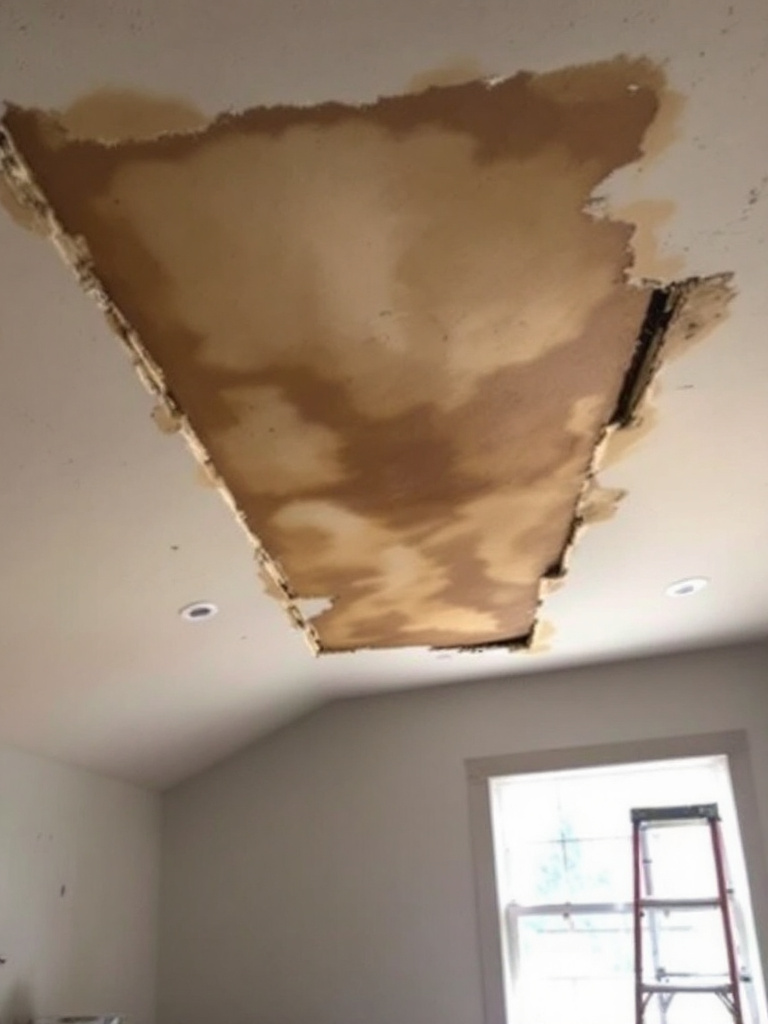
If the ceiling is bulging, don't wait for it to decide. Put a bucket under it, poke a small hole at the lowest point with a screwdriver to let the water out in a controlled stream, and turn off the breaker for any light fixture or fan in that ceiling. If the water is still coming, shut off the house supply. If it's raining, it's the roof; if it's not, it's plumbing or the air conditioner.
Ceiling repair after water damage runs $325 to $1,100 and drywall $1.50 to $3 per square foot, on top of drying at $3 to $4.25 per square foot of affected area (Fixr, January 2025, source Bob Vila, May 2023, source.
The four usual sources in DFW houses
Attic air handler. In 1990s and 2000s two-stories across Plano, Frisco, Allen, Flower Mound and Mansfield, the air conditioner's indoor unit is in the attic, and in summer it produces gallons of condensate a day. When the primary drain line clogs with algae, the water goes into the secondary pan; when the pan rusts, the float switch sticks or the pan's drain shares the clogged line, it goes into the ceiling. A stain that appears in July under the attic unit is this.
Attic water heater. Same houses, same attic. The tank's pan is supposed to catch a failure and drain outside; a stain near the pan drain's outlet or a bedroom ceiling that went soft overnight is the tank. Upstairs bathroom. A toilet wax ring, a cracked supply line, a shower pan that failed, or grout that let water behind the tile shows up on the ceiling below the bathroom, often around a light fixture. Roof. After a hailstorm or wind event, a lifted shingle or a failed pipe boot lets rain in, and the stain appears at the first obstruction the water hits.
What the crew does
They meter the ceiling and the walls below it to find the full wet area, which is usually two to three times the size of the stain. They open the ceiling where it's saturated, remove wet insulation above it (blown-in insulation holds water and doesn't dry), and check the joists and the top plates of the walls. If water ran down inside a wall, the base of that wall gets opened too. Then air movers angled into the cavity, a dehumidifier in the room, and daily readings until dry.
Sagging or stained drywall is replaced, not dried; once the paper face has delaminated it won't hold texture. The rebuild is new drywall, tape, texture matched to the existing ceiling (DFW ceilings are usually orange peel or knockdown), primer and paint, and new insulation above. Matching texture is the skill that separates a patch you'll see from one you won't.
What it costs in Dallas-Fort Worth
Fixr's January 2025 guide puts ceiling water damage repair at $325 to $1,100 and drywall restoration at $1.50 to $3 per square foot, with typical drywall repairs at $275 to $485. Bob Vila's guide lists ceilings at $350 to $1,250 and drywall at $300 to $800. Those are rebuild numbers. Drying first is priced per square foot of affected area at the clean-water rate of $3 to $4.25 per square foot, so a bedroom ceiling leak that needed three days of equipment plus a four-by-eight ceiling patch typically lands between $900 and $2,500 all in. If the ceiling came down across a room and the floor below was soaked, $3,000 to $6,000 is realistic. Fixing the source (the plumber or HVAC tech) is a separate bill.
What moves the price
Size of the wet area, whether insulation has to be replaced, whether a wall below was also wet, and the texture. A smooth ceiling patch is easy; a hand-troweled knockdown match in a 20-foot vaulted living room is not. Water that sat for days before you noticed (common with a slow condensate pan leak) means more drywall out and a higher chance of mold on the back side, which brings Texas mold rules into play once it's over 25 contiguous square feet. A ceiling with a fan or recessed lights adds an electrician.
How long it takes
Three to five days of drying, then two to four days of rebuild spread over a week or so for drywall, texture, and paint to cure between coats. Add time if insulation has to be re-blown or if your insurer wants to inspect before the ceiling is closed. Ask your contractor to photograph the open cavity and the dry readings before it's sealed; it's the proof you'll want if there's ever a mold question.
What to ask
Ask them to find and show you the source before they close anything. Ask whether the insulation is being replaced. Ask for a texture sample on a scrap before they do the ceiling. Ask whether the walls below were metered. Ask whether the attic unit's secondary pan and float switch were checked, because the same leak will happen next July if they weren't. And get the HVAC tech's or plumber's invoice; your adjuster will want it to confirm the loss was sudden.