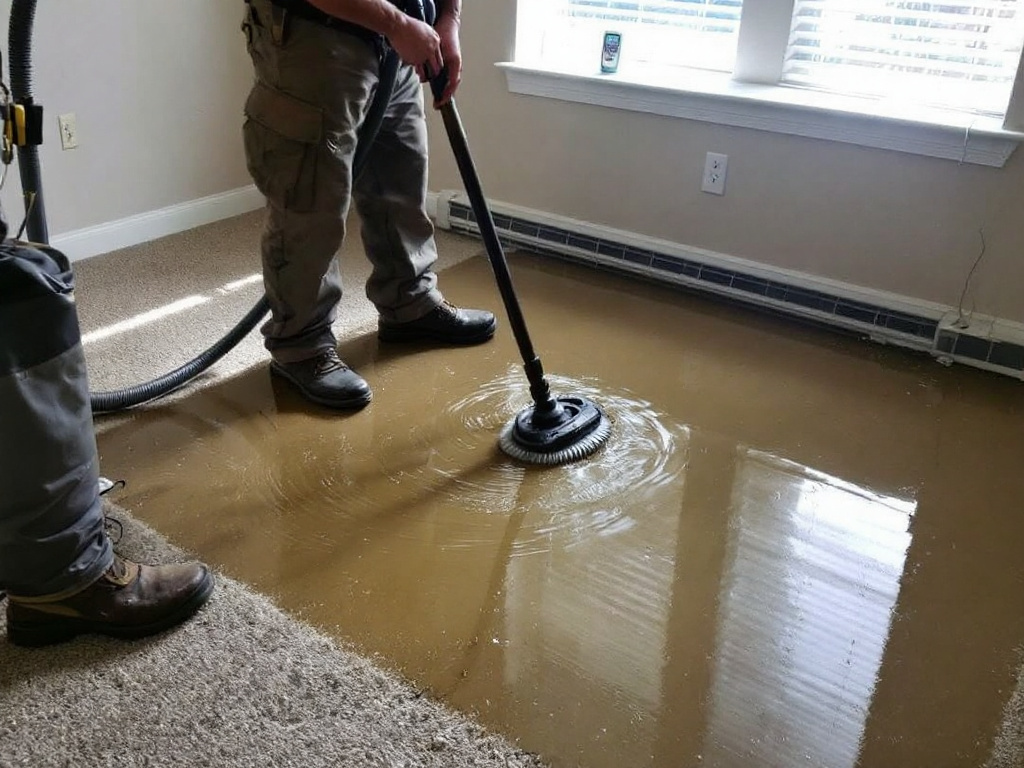
This page is for the night it's happening: the water heater in the attic let go at 2 a.m., the washing machine drain backed up while you were at work, the toilet supply line split and the hall is underwater. Shut the water off at the fixture or the meter first. Then call. Tell the dispatcher how deep the water is, what it came from, and how many rooms it reached.
A one-room clean-water extraction and dry-out in DFW typically runs $500 to $1,500; multi-room or Category 2 losses $2,000 to $4,000, at $3 to $7.50 per square foot by category plus $50 to $200 emergency fees (Fixr, January 2025, source Voda DFW, April 7, 2025, source.
What happens when the crew arrives
They walk the house with a moisture meter and a thermal camera before they start pumping, because the extraction plan depends on where the water actually is, and on a slab it has usually traveled under flooring into the next room. Then the extraction itself: a truck-mount or a portable unit with a weighted or wand head on carpet, a squeegee head on hard floors. Carpet is often saved; carpet pad almost never is, because it holds water like a sponge and can't be dried in place. Floating floors come up because water is trapped underneath them.
After extraction they set air movers at the wall base to push dry air into the wet drywall and a low-grain refrigerant dehumidifier to pull the moisture out of the room air. The equipment runs 24 hours a day until the daily readings hit dry standard, usually three to five days for a clean-water loss. Extraction without drying is half a job: the water you can see is gone but the wall is still wet.
Why the first hours matter more here
The IICRC S500 standard notes that water degrades over time, and that it degrades faster in warm conditions. Clean supply water that sits in a carpeted room through a July weekend in Dallas is no longer clean by Monday, and the EPA's 24 to 48 hour mold window is the short version of why. Dallas homes also make it worse: most are slab-on-grade with no basement to collect water, so it spreads out across living space instead of down into a utility area.
Attic plumbing is the other local factor. In 1990s and 2000s subdivisions across Plano, Frisco, Allen, Flower Mound and Mansfield, the water heater and the air handler sit in the attic. When either one fails, the water comes through a bedroom ceiling and runs down inside the walls. By the time you see the stain, the insulation above it is saturated and the top plate is wet. Extraction on those jobs includes the attic.
What it costs in Dallas-Fort Worth
Extraction and drying are priced together by the square foot. Fixr's January 2025 guide puts clean-water extraction at $3.75 to $4.25 per square foot, gray water at $4.10 to $6.50, and black water at $7 to $7.50, with an emergency service fee of $50 to $200 and a rapid-dispatch fee of $100 to $200 on top for after-hours calls. A Greater DFW restoration company's April 2025 page quotes $3 to $4, $4 to $6, and $7 and up, with a typical one-room clean-water job at $500 to $1,500.
A 300-square-foot living room with an inch of clean water, caught the same day, is usually a $1,200 to $2,000 job including three days of equipment. The same room with the water left over a weekend, now Category 2 with the pad and lower drywall removed, is $2,500 to $4,000. Rebuild is separate.
What affects the price
Category of water, square footage, and how long it sat are the three big ones. After that: carpet versus hard floor (carpet adds pad removal and often carpet disposal), one story or two (a second-floor leak that came through a ceiling doubles the drying area), and whether cabinets or built-ins have to be detached to dry behind them. After-hours and holiday calls add a fee. A job that needs a generator because the power is off, as many did in February 2021, costs more.
How long it takes
Extraction on a typical residential loss takes one to three hours once the crew is on site. Drying equipment stays three to five days for clean water in one or two rooms, five to seven for larger or Category 2 losses. Most of the companies we work with quote arrival inside two to four hours across the core metro and longer for the far edges of Denton and Rockwall counties during a regional event like a freeze, when every truck in DFW is out.
What to ask on the phone
Ask how soon they can be on site and whether that's a commitment or an estimate. Ask what the after-hours fee is. Ask whether they'll give you a written mitigation scope before setting equipment and whether the daily moisture log comes to you. Ask what happens if your insurer wants its own vendor after you've started; the companies we send don't charge a cancellation fee for that. And ask them to bring the certificate of insurance; you're allowed to see it.